How a direct primary care practice doubled its organic clicks in six months.
What results did SEO produce for Vitality Direct Primary Care?
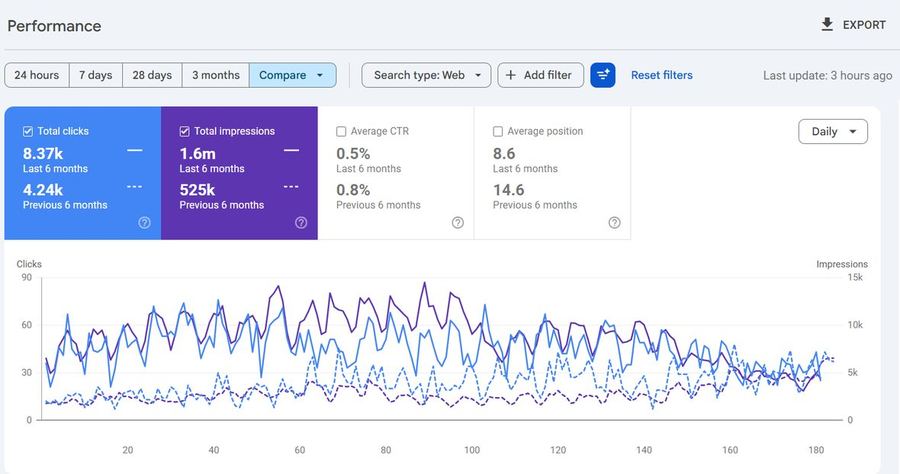
Over six months against the previous six, Vitality Direct Primary Care grew from 4,240 to 8,370 organic clicks and from 525 thousand to 1.6 million impressions, and its average Google position improved from 14.6 to 8.6. That moved the practice from the middle of page two onto page one. The work, led by medical SEO specialist Muhammad Haseeb Sheikh, mapped condition and service pages to local patient searches and pointed internal links at the pages that convert. Every figure comes from the practice's own Search Console and Business Profile.
A membership practice has no insurer directory sending it patients, so search has to do that job. When I started with Vitality Direct Primary Care, the practice sat in the middle of page two for the local searches that matter, behind larger providers. Six months later it averaged position 8.6 on page one and its organic clicks had roughly doubled. Here is what held it back, what I changed, and what the numbers do and don't show.

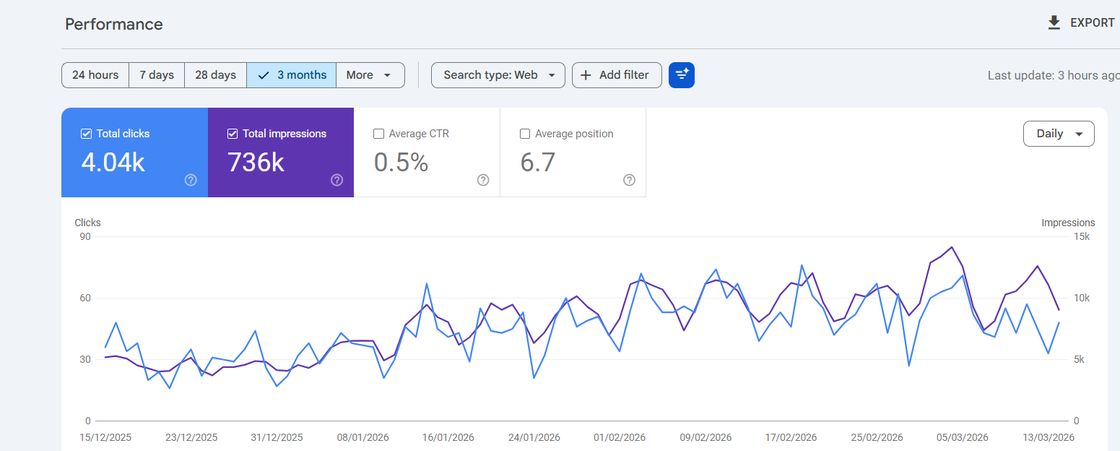
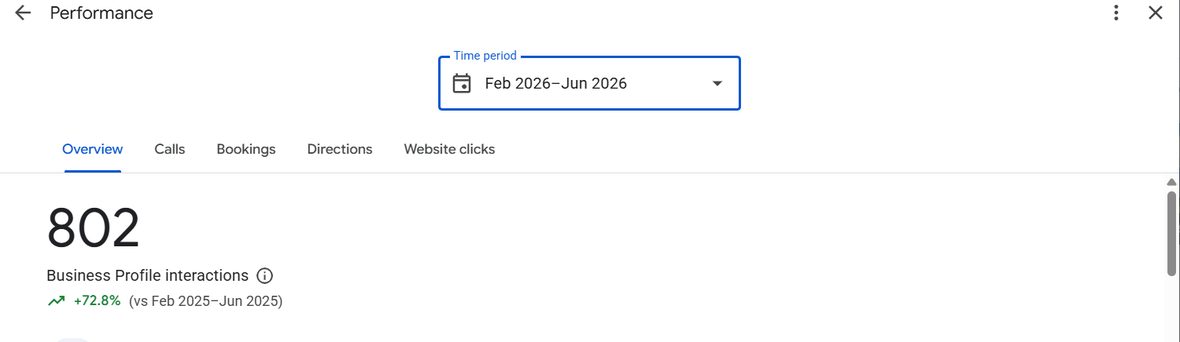
Vitality Direct Primary Care, a membership-model practice, had thin organic visibility and was competing for local searches against larger providers. I, Muhammad Haseeb Sheikh, built condition and service pages mapped to the searches local patients make, and rebuilt internal links so authority flowed to the pages that convert. Over six months organic clicks rose from 4.24k to 8.37k, impressions from 525k to 1.6m, and average position improved from 14.6 to 8.6. A later quarter held at position 6.7, and the practice's Business Profile logged 802 interactions from February to June 2026, up 72.8% on a year earlier.
What it meant for the practice
What did doubling organic clicks mean for a DPC practice?
It meant roughly twice as many people reaching the practice's website from Google, and the practice showing on page one for the local searches where people choose a doctor. For a membership practice, every one of those visitors is someone who might join for years, not for a single visit.
Business Profile interactions are calls, bookings, direction requests and website clicks made straight from Google Search and Maps. They rose 72.8% year on year. For a local practice, that is closer to new members than any ranking number.
The 2025 figure is worked out from the 72.8% change shown on the dashboard. The 802 interactions and the search figures are read directly from the practice's own accounts.
01 · The business
Why does search matter more for a direct primary care practice?
Vitality Direct Primary Care is a membership practice: patients pay a monthly fee for direct access to their doctor instead of billing insurance. That model has a marketing cost most practices never face. Insurer directories, the place many people look for a doctor, don't list it.
So people have to find the practice themselves, mostly by searching Google and Google Maps for a doctor nearby or a way around insurance, and then understand the membership model before they call. If the practice isn't visible for those searches, it simply isn't considered.
I cover how patients move from a search to membership, and where they drop off, in how patients find a direct primary care practice.
02 · The starting point
What was holding the practice back?
Relevance. The practice had thin organic visibility: it sat around the middle of page two, average position 14.6, for the local searches that bring members in, while larger local providers held page one.
Google didn't have the right pages to show. People were searching for specific services and conditions near them, and the site lacked a page built for many of those searches, so it ranked for them weakly or not at all. More content of the wrong kind wouldn't have fixed that; the right pages, linked so Google could see which mattered, would.
03 · The execution
What did I change on Vitality's website?
Two things, in that order, following the constraint-first sequence: build what patients were searching for, then make sure Google could tell which pages counted.
Condition and service pages mapped to local searches
- One page per search that matters. Each important service and condition got its own page, written the way local patients describe it, instead of a single list of services.
- Local intent first. Pages were matched to the searches people make near the practice, so they competed where membership decisions happen.
Internal links that concentrate authority
- Links pointed at the pages that convert. Internal links across the site were restructured so authority flowed to the service and condition pages most likely to turn a visitor into a member.
- A clear hierarchy for Google. The structure told Google which pages mattered most, so rankings rose across the board instead of one page spiking.
04 · The metrics, defined
What do Vitality’s Search Console and Business Profile numbers measure?
They come from Google Search Console and Google Business Profile. For the wider list a practice should watch, see which SEO metrics a medical practice should track.
05 · The results
What changed, before and after?
Clicks and impressions grew together while average position improved, which is the signature of rankings rising across many searches rather than one lucky page. The bars compare the six months before with the six months after.
The six-month curve, straight from Search Console
A later quarter: the gains held
And more people acted on the listing
Want the same read on your practice?
The free diagnostic finds the one thing holding your membership growth back and the first fix, within two business days.
06 · The pace
How fast did the results come?
Fast at first, then steadier. Most of the six-month gain came in the first three months; the last two months flattened. That is a normal shape once the main missing pages exist and rank: the early jump comes from filling the gaps, and what follows is holding and slowly extending the share of local demand.
The later quarter, from December 2025 to March 2026, shows the position improved further to 6.7 on average, so the flattening was a plateau, not a slide.
07 · The honest read
What made the difference for Vitality, and where are the limits?
What did the heavy lifting
- Pages for real local searches. Giving Google a page for each service and condition people search for was the biggest lever.
- Internal links with a purpose. Concentrating authority on the pages that convert lifted rankings across the site, not just on one page.
The honest limits
- Local demand is finite. Growth for a membership practice is about winning a larger share of a defined market, not chasing raw volume, which is why the curve flattened.
- Profile interactions have more than one cause. The 72.8% rise sits alongside the search gains, but reviews, seasonality and word of mouth also move it.
- One practice's results. The method repeats; the exact numbers depend on the market, competition and starting point.
08 · For other practices
What can other DPC practices learn from Vitality’s new pages?
- Build for the searches, not the service menu. Patients search for conditions and access, not for the words on your brochure.
- Point your links at the pages that convert. A site where every page links to the home page wastes the authority it has.
- Judge it in members, not rankings. Watch Business Profile actions and calls alongside clicks, and give it a quarter before drawing conclusions.
This is the work behind my SEO service for direct primary care practices. The other DPC result, Purposeful Healing’s 38% rise in clicks in one quarter, is in the Purposeful Healing DPC case study.
09 · Questions
Frequently asked questions
How long did it take Vitality Direct Primary Care to see SEO results?+
Does SEO work for a direct primary care practice?+
Is a result like this repeatable for other DPC practices?+
Where do Vitality Direct Primary Care’s numbers come from?+
Find out what is slowing your membership growth.
Book a free 30-minute call, or send your site for a written diagnostic within two business days. Either way you get the one constraint, the first fix, and why.
Running an agency with DPC clients? I deliver this same work under your brand as white-label healthcare SEO for agencies.