How a DPC practice grew clicks 38% in one quarter without writing a new page.
What results did SEO produce for Purposeful Healing DPC?
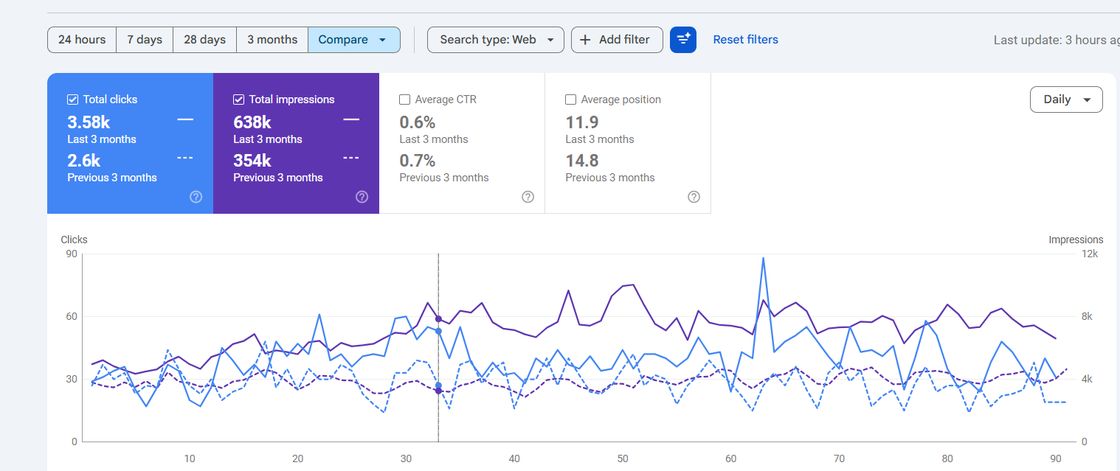
In one quarter against the quarter before, Purposeful Healing DPC grew from 2,600 to 3,580 organic clicks, up 38%, and from 354 thousand to 638 thousand impressions, up 80%. Its average Google position improved from 14.8 to 11.9. Medical SEO specialist Muhammad Haseeb Sheikh remapped the practice's existing pages to the searches patients actually make and rebuilt its internal structure before publishing anything new. Every figure comes from the practice's own Search Console.
Purposeful Healing DPC didn't have a content shortage. It had pages, but they didn't match how patients searched, so they ranked for the wrong things and brought in the wrong visitors. Instead of writing more, I changed what the existing pages were about and how they connected. One quarter later clicks were up 38% and impressions 80%. Here is what I changed, what the numbers show, and where the practice still has room to grow.

Purposeful Healing DPC, a membership-model practice, had content that didn't match how patients searched, so its pages ranked for the wrong searches and converted poorly. I, Muhammad Haseeb Sheikh, remapped the existing pages to real patient intent and rebuilt the internal structure, without publishing anything new first. Against the previous quarter, organic clicks rose 38% from 2.6k to 3.58k, impressions rose 80% from 354k to 638k, and average position improved from 14.8 to 11.9.
What it meant for the practice
What did a 38% rise in clicks mean for a DPC practice?
About 980 more people reached the practice's website from Google in a single quarter, without a single new page. For a membership practice, each of those visitors is a potential member for years, and the work that brought them keeps paying back as long as the pages are maintained.
The difference came from the pages the practice already had, rewritten and reconnected so they matched what patients search for. That is the cheapest growth a practice can buy: no new content budget, just the right pages pointed at the right searches.
The 980 is the difference between the two quarters' clicks shown on the dashboard. It counts visits, not new members.
01 · The starting point
Why wasn't the practice's existing content bringing in patients?
Because it didn't match how patients searched. The pages existed, but they were written around how the practice described itself rather than the words people use when they look for a doctor, so they ranked for the wrong searches and the visitors they did attract weren't looking to join.
Intent, not volume. Writing more pages in the same way would have added more mismatched content. The constraint was that the existing pages answered the wrong questions, and their internal links didn't tell Google which pages mattered most.
This is common for direct primary care practices, because the model is unfamiliar and practices naturally describe it in their own terms. I cover the searches patients really make in how patients find a direct primary care practice.
02 · The execution
What did I change instead of writing new content?
Two things, both on pages the practice already had, following the constraint-first sequence: fix what exists before adding more.
Remapped existing pages to real patient intent
- One clear search per page. Each existing page was given a single job: the search a patient makes, in the patient's words.
- Reshaped around what patients ask. Where a page missed, its content was adjusted to answer the question behind its search rather than the practice’s own description of itself.
Rebuilt the internal structure
- Links that show what matters. Internal links were reorganized so authority flowed to the remapped pages that bring in prospective members.
- Nothing new until the base worked. New pages come after the existing ones rank for the right searches, not before.
03 · The metrics, defined
What do Purposeful Healing’s Search Console numbers measure?
They come from Google Search Console. For the wider list a practice should watch, see the SEO metrics worth tracking for a practice.
04 · The results
How much did Purposeful Healing grow in one quarter?
Impressions climbed after the changes and stayed above the previous quarter, and clicks followed. The bars compare the quarter before the work with the quarter after.
Purposeful Healing’s quarter in Search Console
Already have pages that aren't bringing patients?
The free diagnostic shows whether your existing pages match what patients search for, and the first fix, within two business days.
05 · Reading the numbers
Why did click-through rate dip while clicks rose?
Because impressions grew faster than clicks. Once the pages matched real searches, Google began showing them for many searches it hadn't shown them for before, often lower down the results at first. Those new appearances add impressions quickly and clicks more slowly, so the overall CTR fell from 0.7% to 0.6% even as total clicks rose 38%.
That pattern is normal early on and usually means the site is earning new ground, not losing it. It is also why I judge results on clicks, calls and bookings rather than any single ratio.
06 · The honest read
What made remapping work, and where are the limits?
What did the heavy lifting
- Matching pages to intent. Turning existing pages toward the searches patients make was the whole lever; no new content was needed to get here.
- Structure before volume. Rebuilding internal links meant the remapped pages had the authority to move.
The honest limits
- Still page two on average. An average position of 11.9 is better, but it isn't page one yet. There is more growth available.
- One quarter. This compares two consecutive quarters, so seasonality can play a part. A longer window will show how much of the gain holds.
- Visits, not members. The dashboard measures search visits. How many became members depends on the practice's pricing, trust signals and enrollment path.
07 · Page two to page one
What usually moves a practice from page two onto page one?
Once pages match intent, the next limits are usually trust and coverage: more reviews and stronger local signals, clear clinician pages, links from real local and medical organizations, and new pages for the searches the existing site still doesn't cover. That is the stage where adding content starts to pay, because the foundation underneath it now works.
For comparison, another direct primary care practice I worked with moved from position 14.6 onto page one at 8.6 in six months by building pages for the searches it was missing. That story is in the Vitality DPC SEO case study.
08 · For other practices
What can DPC practices learn from remapping existing pages?
- Audit before you write. If you already have pages, check whether they match what patients search before paying for new ones.
- Use patients' words, not your own. Describe care the way people search for it: problems, access and cost, not the model's jargon.
- Give it a quarter. Intent fixes can move within a few months, but judge them on clicks and calls over a full quarter.
This is the work behind my SEO service for direct primary care practices, and the same constraint-first approach runs through every SEO case study on this site.
09 · Questions
Frequently asked questions
Can a practice grow from search without publishing new content?+
Why did impressions grow faster than clicks?+
Did Purposeful Healing DPC reach page one?+
Where do Purposeful Healing DPC’s numbers come from?+
Find out whether your pages match what patients search.
Book a free 30-minute call, or send your site for a written diagnostic within two business days. Either way you get the one constraint, the first fix, and why.
Running an agency with DPC clients? I deliver this same work under your brand as white-label SEO for agencies.