How Patients Find a Direct Primary Care Practice (and Drop Off)
How patients find a direct primary care practice, from 'DPC near me' searches to referrals, and the five points where they drop off before joining.

In this guide10 sections
- Where do direct primary care patients come from?
- What do patients search for before they find a DPC practice?
- How do referrals turn into members?
- Do employers and directories send DPC patients?
- Where do prospective DPC patients drop off?
- How do you measure where DPC patients drop off?
- What does a DPC website need to turn visitors into members?
- Which patients are most likely to join a DPC practice?
- How long does it take a DPC practice to grow through search?
- Where should a DPC practice start?
How do patients find a direct primary care practice?
Patients find a direct primary care practice in four main ways: searching Google and Google Maps for a doctor nearby or a way around insurance, hearing about it from a friend or employer and then searching its name, finding it in a DPC directory, or meeting the doctor at a community event. Almost every route ends with a search, so the practice’s Business Profile, reviews, pricing page and enrollment path decide whether they join.
I’m Muhammad Haseeb Sheikh, a medical SEO specialist who has worked with three direct primary care practices. The same pattern shows up in all of them: plenty of people are curious, and too few become members. This guide maps where DPC patients come from, then walks through the five points where they drop off and the fix for each. Everything here applies to membership practices in the US; the wider service is SEO for direct primary care practices.
Where do direct primary care patients come from?
Four routes bring almost every new member. What matters is that they meet in the same place: a search for your practice before anyone picks up the phone.
- Route 1 · SearchGoogle and Google Maps
People searching for a doctor nearby, a way around insurance, or what direct primary care costs.
- Route 2 · ReferralsFriends, family and other doctors
The strongest route, but referred patients still search your name, read reviews and check your prices.
- Route 3 · Employers and directoriesBenefits offers and DPC listings
Small employers offering DPC, and directories such as the DPC Frontier Mapper.
- Route 4 · CommunityTalks, events and local press
Meeting the doctor in person builds trust, and sends people home to search the practice.
What do patients search for before they find a DPC practice?
Most don’t search “direct primary care” at all. They search for the problem they want solved, and the practice that answers that problem is the one they discover.
- A doctor nearby: “family doctor near me”, “primary care doctor” plus your town, or “direct primary care near me” from people who already know the model. These are decided mostly on Google Maps.
- A way around insurance: a doctor who doesn’t take insurance, a cash-pay doctor, or affordable primary care without insurance. These need a page that explains membership plainly.
- Access: same-day appointments, a doctor you can text, or longer visits. These are the frustrations DPC solves, and good pages lead with them.
- Cost: what direct primary care costs per month, and whether it works with a health savings account. These need a pricing page with real numbers.
- Comparisons: direct primary care against concierge medicine, insurance or a health-share plan. These need a straight answer written for patients.
If your practice doesn’t appear for any of these, start with the seven reasons a clinic isn’t showing on Google.
How do referrals turn into members?
A referral starts the decision; a search finishes it. Someone hears about your practice from a friend, then searches your name to see the reviews, the doctor’s face and the price. If that search shows an incomplete Business Profile, a handful of reviews or a website that hides its pricing, the referral goes nowhere.
So the best way to make word of mouth work harder is to make the search that follows it convincing: a complete profile, a steady flow of reviews from current members, a clear doctor bio and visible prices. Ask happy members to leave a review as part of a visit, not by a mass email once a year.
Do employers and directories send DPC patients?
Yes, though in smaller numbers than search and referrals. Some small businesses offer a DPC membership as a benefit, which can add several members at once. Employer deals are won through relationships, not search, but the business owner will still look you up before signing.
Directories help patients who already know the model. The DPC Frontier Mapper lists more than 3,000 practices across the US. Make sure your listing is there and that its name, address and phone number match your website and Business Profile exactly.
Where do prospective DPC patients drop off?
At five points between finding you and joining. Each one loses people for a different reason, so measure them separately and fix the first one that leaks.
- 1 · FoundThey see your practice in search, on the map or in a directory.
- 2 · Understood
They grasp what direct primary care is and how membership works.
- 3 · PricedThey find the monthly fee and what it includes.
- 4 · TrustedThey feel they know the doctor and believe the reviews.
- 5 · JoinedThey book a meet-and-greet, call or enroll.
Drop-off 1: they can’t find you
Sign: few Business Profile views or website impressions for local searches. Fix: a verified, complete Business Profile with the right categories, one page for each service and condition you want to be found for, and consistent listings everywhere, including DPC directories.
Drop-off 2: they don’t understand direct primary care
Sign: visitors land on the home page and leave quickly. Fix: a plain-language page that explains how membership works, what happens when someone needs a specialist or lab work, and how DPC fits with insurance or a health-share plan. Lead with the problems it solves, such as rushed visits, long waits and surprise bills, before the features.
Drop-off 3: they can’t find the price
Sign: people call only to ask what it costs, or a pricing page gets plenty of views and few clicks onward. Fix: a pricing page linked from the main menu, with every tier, what’s included, what isn’t, and an example of what a typical patient pays over a year.
Drop-off 4: they don’t trust you yet
Sign: visitors read the about page and pricing, then leave. Fix: a real doctor bio with a photo and credentials, reviews that mention what members value, and a short video or a meet-and-greet offer so people can meet the doctor before committing.
Drop-off 5: joining takes too much effort
Sign: people click “join” and don’t finish. Fix: fewer steps. Offer a free meet-and-greet booking, a call button that works on mobile, and an enrollment form that asks only for what you need on day one.
How do you measure where DPC patients drop off?
Give each stage one number and check them monthly.
| Stage | Number to watch | Where to find it |
|---|---|---|
| Found | Business Profile views and non-branded search impressions | Business Profile, Search Console |
| Understood | Engagement on the “how it works” page | GA4 |
| Priced | Visits to the pricing page, then clicks onward | GA4 |
| Trusted | Reviews gained and doctor-page visits | Business Profile, GA4 |
| Joined | Meet-and-greet bookings, calls and enrollments | Booking system, Business Profile |
When one stage drops much more sharply than the others, that is where to work first. For the full list of numbers worth tracking, see the SEO metrics a medical practice should track.
What does a DPC website need to turn visitors into members?
A short checklist covers most of it:
- A home page that says who the practice is for and what problem it solves, in the first screen.
- A “how it works” page that explains membership, specialists, labs and insurance.
- A pricing page with every tier, in the main menu.
- A doctor page with a photo, credentials and why they chose direct care.
- Reviews from current members, shown next to the pricing and booking buttons.
- A meet-and-greet or call button on every page, working properly on mobile.
- Service and condition pages for the care people search for in your area.
Which patients are most likely to join a DPC practice?
The people the model helps most: those without insurance or with high deductibles, self-employed people and small-business owners, families who want fast access to the same doctor, and people tired of rushed appointments. Write your home page and pricing page for the one or two groups you serve best. A message aimed at everyone tends to persuade no one.
How long does it take a DPC practice to grow through search?
Months, not weeks. Profile and technical fixes can show within weeks; meaningful growth usually takes three to six months.
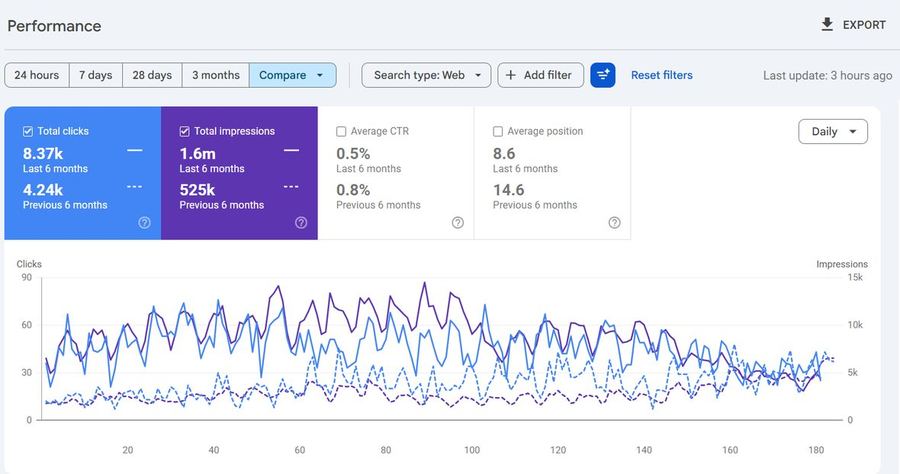
Vitality Direct Primary Care · six months against the previous six: organic clicks 4.24k to 8.37k, average position 14.6 to 8.6, from the middle of page two onto page one. Most of the gain came in the first three months. The Vitality case study has the details.
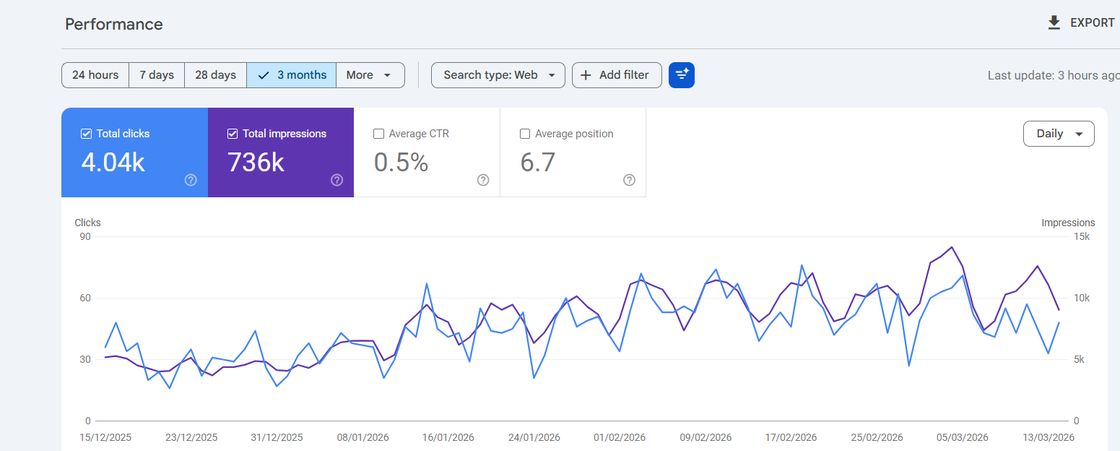
Vitality Direct Primary Care · a later quarter, December 2025 to March 2026: 4.04k clicks, 736k impressions and an average position of 6.7. The gains held once the foundation was in place.
Local demand is finite, so growth for a DPC practice is about winning a larger share of the people near you who are already looking, not chasing national traffic that will never join.
Where should a DPC practice start?
With the stage that leaks most. If nobody finds you, fix the profile and pages. If they find you and leave, fix the explanation, pricing and trust. If they get to “join” and stop, fix the enrollment path. My SEO service for direct primary care practices starts by finding that one stage, and the free growth diagnostic names it for your practice within two business days.
Frequently asked questions
Should a direct primary care practice show its prices on its website?
Yes. Price is the first question most people have about direct primary care, and a visitor who can't find it usually leaves to look at a practice that shows it. Publish your membership tiers, what each includes and what isn't covered.
Is word of mouth or search better for growing a DPC practice?
They work together. Most referred patients still search your name before they call, so a referral only turns into a member if your Business Profile, reviews and website hold up when they look.
Does a DPC practice need a Google Business Profile if it doesn't take walk-ins?
Yes. The Business Profile is what puts a practice on Google Maps and in the map results for searches like direct primary care near me, and it is where referred patients check your reviews.
How long does it take a DPC practice to grow through search?
Expect the first movement within weeks of fixing technical and profile problems, and meaningful growth in three to six months. One DPC practice I worked with doubled its organic clicks in six months, with most of the gain in the first three.