How a family practice went from invisible to competing in one quarter.
What results did SEO produce for Jersey Family Health?
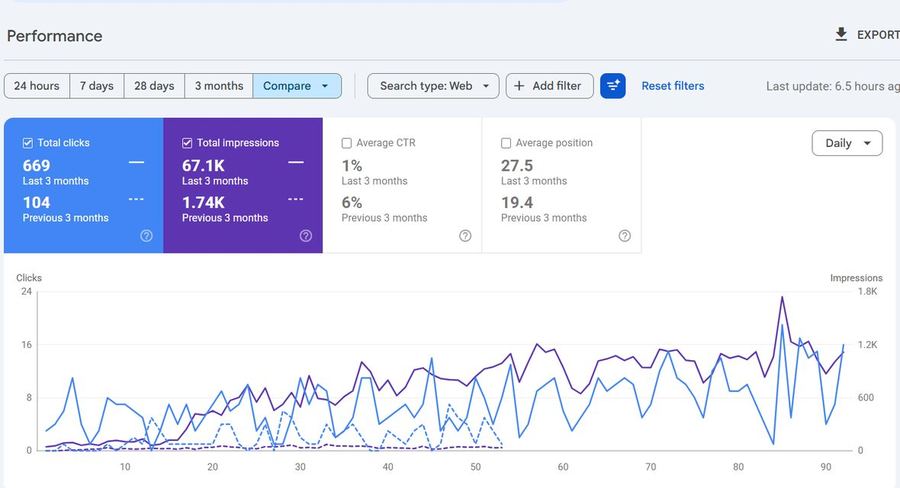
In one quarter against the quarter before, Jersey Family Health grew from 104 to 669 organic clicks and from 1,740 to 67,100 impressions. That followed the work of medical SEO specialist Muhammad Haseeb Sheikh who cleared the indexing problems keeping most of its site out of Google and built service and condition pages in the words patients use. Average position fell from 19.4 to 27.5 and click-through rate from 6% to 1% over the same period, because the practice began ranking for thousands of new searches that enter low. Every figure comes from the practice's own Search Console.
Jersey Family Health was almost invisible in Google. It showed up when people searched its name and barely anywhere else, because most of the site wasn't indexed and there were no pages for the conditions and services patients search for. One quarter after fixing both, clicks were more than six times higher. Two numbers got worse at the same time, and this case study explains why that is a good sign, not a bad one.

Jersey Family Health, a family practice, had almost no organic footprint: it ranked for a handful of searches for its own name and was absent for the conditions and services patients type. I, Muhammad Haseeb Sheikh, cleared the indexing problems keeping most of the site out of Google and built service and condition pages written the way patients describe their symptoms. Against the previous quarter, clicks rose from 104 to 669 and impressions from 1.74k to 67.1k. Average position and click-through rate fell, because the site went from ranking for a few dozen searches to thousands.
What it meant for the practice
What did going from 104 to 669 clicks mean for a family practice?
It meant the practice started reaching people who didn't already know its name. Before, almost every visit came from someone searching for the practice itself. After, people searching for symptoms, conditions and services near them began to find it: about 565 more visits in a single quarter.
The numbers are still modest in absolute terms, and that is the point of showing them: this is what the first quarter of real visibility looks like for a practice that started from almost nothing.
The 565 is the difference between the two quarters' clicks shown on the dashboard. It counts visits, not new patients.
01 · The starting point
Why couldn't patients find the practice on Google?
Two problems stacked on top of each other. Most of the site wasn't in Google's index at all, so its pages couldn't rank for anything. And the pages that did exist didn't cover the conditions and services patients search for, so even an indexed site would only have shown up for the practice's own name.
Access first, then relevance. Until Google could index the site, no amount of new content would have shown up; and once it could, there had to be pages that matched the searches patients make.
Both are among the seven reasons a clinic isn’t showing on Google, and they are the two I check first.
02 · The execution
What did I change on the practice's website?
Two things, in the order the constraint-first method calls for: fix access, then build relevance.
Cleared the indexing problems
- Let Google in. The problems keeping most of the site out of Google's results were found and cleared, so its pages became eligible to rank.
- Access before content. Nothing new was worth writing until the existing site could be indexed.
Built pages in patients' words
- Service and condition pages. Pages were built for the conditions and services patients search for, so the practice had something to show for those searches.
- Symptoms, not clinical names. Each page describes care the way patients describe their problem, rather than the way clinicians name it.
03 · The metrics, defined
What do Jersey Family Health’s Search Console numbers measure?
They come from Google Search Console. For which numbers a practice should actually report, see calls, not rankings: the metrics that matter.
04 · The results
How much did the practice’s visibility grow in one quarter?
Visibility exploded and visits followed. The bars compare the quarter before the work with the quarter after; the previous quarter's bars are short because the practice was barely appearing at all.
Jersey Family Health’s quarter in Search Console
Is most of your site missing from Google?
The free diagnostic checks whether Google can index your practice's site and which searches it's missing, within two business days.
05 · Reading the numbers
Why did average position and click-through rate get worse?
Because the site went from ranking for a few dozen searches to thousands, and new rankings start low. Before, the practice appeared mainly for searches for its own name, where it ranked well and was clicked often. After, it also appeared for thousands of condition and service searches, most of them on page two or three at first.
Averages treat every search equally, so those thousands of new, lower rankings pulled average position down from 19.4 to 27.5. They also add impressions much faster than clicks, so click-through rate fell from 6% to 1%, even though total clicks rose more than sixfold.
A practice that ranks third for its own name and nothing else has a great average position and almost no visitors. Add a thousand new searches at position thirty, and the average gets worse while the visits go up. That is why I report calls and clicks first, and treat average position as a diagnostic. The same thing happened to a software platform whose average slipped from 5.2 to 11.1.
06 · The honest read
What made the difference for the practice, and where are the limits?
What did the heavy lifting
- Fixing indexing. Letting Google see the site was the precondition for everything else.
- Pages in patients' words. Condition and service pages written around symptoms gave Google something to show for the searches patients make.
The honest limits
- Early stage. This is the first quarter of visibility, shown mid-flight rather than waiting for a prettier chart. The averages should tighten as the stronger pages mature, but that is still to come.
- Small absolute numbers. 669 clicks a quarter is a start, not a finished result. The growth rate is large because the starting point was close to zero.
- Visits, not patients. The dashboard counts search visits. Calls and bookings depend on the practice's pages, reviews and how easy it is to book.
07 · For other practices
What can other family practices learn from this?
- Check indexing before anything else. If most of your site isn't in Google, new content won't show up either.
- Write for symptoms. Patients search for what they feel, not for clinical names. Build pages around that.
- Don't panic at falling averages. When reach grows fast, average position and CTR usually fall first. Judge the work on clicks, calls and bookings.
This is the work behind my medical SEO service for family and specialty practices, and of SEO for family practices in particular. For a practice further along the same path, the allergy clinic case study shows what six months looks like, the multi-service clinic case study shows another practice building from near zero, and every result is on the case studies page.
08 · Questions
Frequently asked questions
Why did Jersey Family Health's average position get worse?+
Is a falling click-through rate bad for a practice?+
How long does SEO take for a family practice?+
Where do Jersey Family Health’s numbers come from?+
Find out what is keeping your practice out of Google.
Book a free 30-minute call, or send your site for a written diagnostic within two business days. Either way you get the one constraint, the first fix, and why.
Running an agency with clinic clients? I deliver this same work under your brand as white-label healthcare SEO for agencies.