How a restaurant ordering platform more than doubled its search clicks in one quarter.
What results did SEO produce for this B2B SaaS restaurant platform?
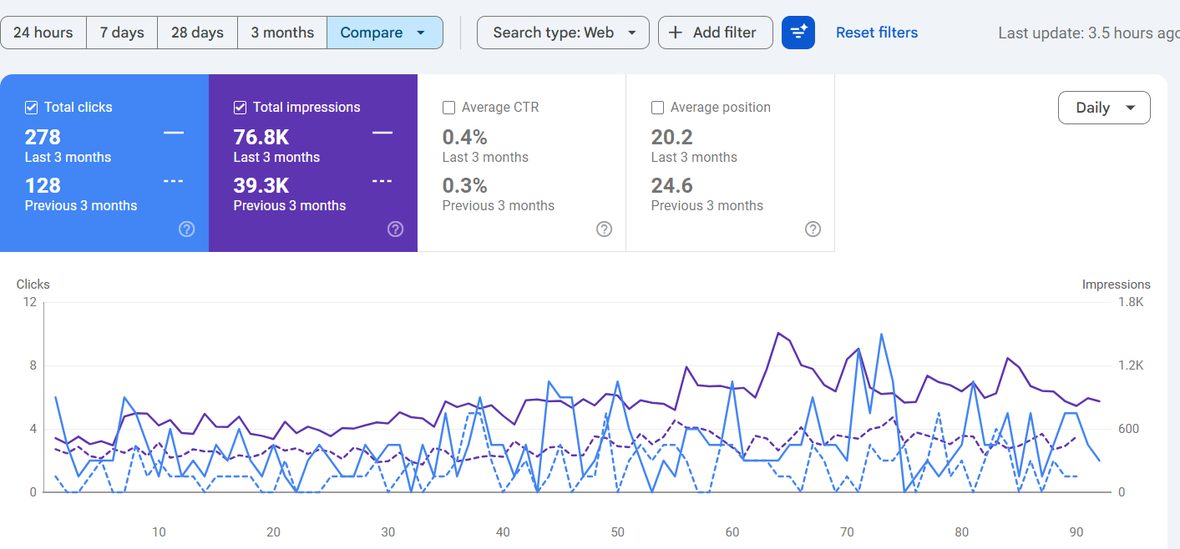
In one quarter against the quarter before, a B2B restaurant ordering platform grew from 128 to 278 organic clicks, up 117%, and from 39,300 to 76,800 impressions. Its average Google position improved from 24.6 to 20.2 and click-through rate from 0.3% to 0.4%. SEO specialist Muhammad Haseeb Sheikh set the technical baseline, remapped pages to what restaurant buyers search for, and rebuilt internal links to concentrate authority. Every figure comes from the platform's own Search Console.
This software company sells an ordering platform to restaurants. Its commercial pages sat on page two and three of Google, an average position of 24.6, so the product was invisible exactly where restaurant owners were comparing options. One quarter after fixing the order of the basics, clicks had more than doubled and every headline metric had improved. The numbers are small, because the market is a niche, and this case study says so.

A B2B restaurant ordering platform ranked on page two and three for the searches its buyers make. I, Muhammad Haseeb Sheikh, set the technical baseline first, then remapped the site's pages to what restaurant owners actually search for, then rebuilt internal links so authority reached the pages that sell. Against the previous quarter, organic clicks rose 117% from 128 to 278, impressions roughly doubled from 39.3k to 76.8k, average position improved from 24.6 to 20.2 and click-through rate from 0.3% to 0.4%.
What it meant for the platform
What did doubling search clicks mean for a B2B SaaS product?
It meant 150 more visits a quarter from people searching for the kind of software the company sells, with every quality signal moving in the same direction. In a niche B2B market, the number of people searching is small, so who those visitors are matters more than how many there are.
Clicks grew faster than impressions, and click-through rate rose. That is the opposite of the usual early pattern, where reach grows first and clicks lag. Here the pages most likely improved their positions for searches they already appeared in, as well as reaching new ones.
The 150 is the difference between the two quarters' clicks shown on the dashboard. It counts visits, not sign-ups or demos.
01 · The starting point
Why couldn't restaurant buyers find the product?
Because its commercial pages ranked on page two and three. An average position of 24.6 meant that for the searches restaurant owners make when they look for an ordering system, the platform appeared below most of its competitors, where almost nobody looks.
Relevance and authority on the pages that sell. The product pages didn't match what buyers searched for closely enough, and the site's internal links didn't direct authority to them. More blog posts would not have fixed either problem.
02 · The execution
What did I change on the platform’s site, and in what order?
The same sequence I use for every engagement, from the constraint-first method: make sure Google can read the site, make each page match a buyer's search, then point authority at the pages that convert.
1. Technical baseline first
- Nothing else works until this does. The technical baseline was checked and fixed before any page was rewritten, so improvements would actually be crawled and counted.
2. Pages remapped to what buyers search
- One buyer search per page. Pages were remapped to the searches restaurant owners make when they look for ordering software.
3. Internal links that concentrate authority
- Authority where it sells. Internal links were rebuilt so the site's authority flowed to the commercial pages most likely to turn a visitor into a demo or a sign-up.
03 · The metrics, defined
What do the platform’s Search Console numbers measure?
They all come from Google Search Console.
04 · The results
How did the platform’s search numbers change in one quarter?
Impressions climbed through the quarter and clicks grew faster still. The bars compare the quarter before the work with the quarter after.
The platform’s quarter in Search Console
Is your product buried on page two?
The free diagnostic finds the one thing keeping your pages out of buyers' view, and the first fix, within two business days.
05 · The method
Why does a method built for clinics work for software?
Because the constraint changes, not the method. Most of my work is with healthcare practices, but the sequence underneath it is industry-neutral: find the one thing capping growth, fix that first, then move to the next. For a clinic the constraint is often local trust or a missing condition page; for this platform it was relevance and authority on its commercial pages.
The same order produced the allergy clinic's move from page two to page one, and the full sequence is written out in the constraint-first SEO method.
06 · The honest read
What moved the platform’s sales pages, and where are the limits?
What did the heavy lifting
- Order of work. Fixing the technical baseline before touching content meant every later change was counted.
- Buyer language on commercial pages. Matching pages to how restaurant owners search lifted positions, and CTR rose with them instead of falling.
The honest limits
- Small absolute numbers. This is a focused B2B niche, not a volume market. 278 clicks a quarter is meaningful here; it would not be in consumer software.
- Still page two on average. Position 20.2 is better than 24.6 but sits at the bottom of page two. There is more to win.
- One quarter, visits not revenue. The dashboard compares two consecutive quarters and counts visits. Demos and sign-ups depend on the product pages and the sales process.
07 · For other teams
What can SaaS teams learn about ranking their sales pages?
- Fix commercial pages before writing blog posts. The pages that sell are usually the ones furthest from where buyers look.
- Use buyer words, not feature names. Customers search for the job they need done, not for what your team calls the feature.
- Point internal links at the money pages. Authority that pools on the home page and blog doesn't help a product page rank.
If you run an agency with software clients, I deliver this same work under your brand as white-label SEO for agencies. For a software case at an earlier stage, see the hospitality software SEO case study, and for a brand-new product the SaaS launch SEO case study. Every other result, in healthcare and software, is on the SEO case studies page.
08 · Questions
Frequently asked questions
How long does SEO take for a B2B SaaS company?+
Does SEO work for niche B2B software with low search volume?+
Why did click-through rate rise in this case study?+
Why isn't the restaurant ordering platform named?+
Find out what is keeping your product off page one.
Book a free 30-minute call, or send your site for a written diagnostic within two business days. Either way you get the one constraint, the first fix, and why.
Hiring for an SEO role? My background, work history and certifications are on the about page.