How I made organic search a clinic's biggest source of new patients.
What did Muhammad Haseeb Sheikh do for the clinic in this case study?
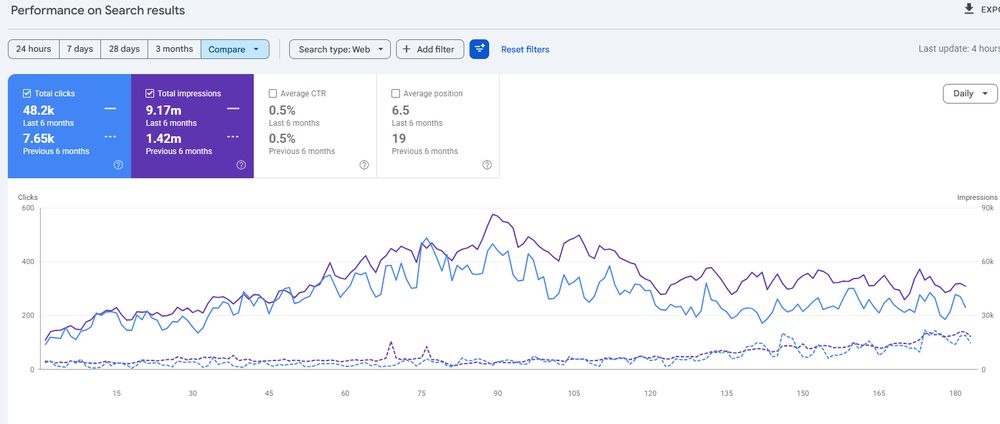
He took a multi-location specialty clinic from the bottom of page two to page one of Google in six months. Organic clicks grew from 7,650 to 48,200 across six months against the previous six, impressions from 1.42 million to 9.17 million, and average position improved from 19 to 6.5. The work followed a constraint-first sequence: technical baseline, pages rebuilt around patient search intent, and strengthened local trust signals. Every figure comes from the client's own Search Console, published with their permission and with account URLs cropped.
When this multi-location allergy and immunology clinic came to me, it was sitting at the bottom of page two for the searches its patients actually type. Six months later it owned the top of page one, organic clicks had grown more than sixfold (7,650 to 48,200 per six months), and the phones were ringing hundreds of times a quarter. Here is exactly what I found, what I did, and what it meant for the practice. The client is Cure Allergy Clinic, named with permission; every number is real.

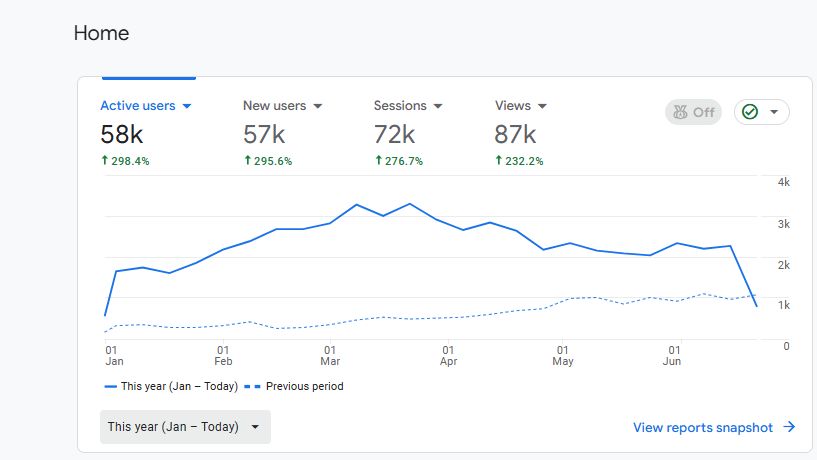
A multi-location allergy and immunology clinic was nearly invisible in Google, ranking around position 19. Over roughly six months I, Muhammad Haseeb Sheikh, an organic growth strategist, rebuilt the site around how patients actually search, strengthened its local presence and trust signals, and cleared the path to booking. Organic clicks rose from 7,650 to 48,200, impressions from 1.42 million to 9.17 million, average position improved from 19 to 6.5, website users grew 298% year on year, and the Google Business Profile generated 891 calls in a single quarter. Organic search became the clinic's number one channel for new patients.
What it meant for the clinic
These are not vanity metrics. They are appointments.
Clicks and impressions are easy to wave away, so let me translate them into the only things a practice owner actually cares about: patients, a fuller schedule, and revenue that does not stop the moment you stop paying for it.
People do not call an allergy clinic to chat. A call is almost always someone trying to book. Even on a deliberately conservative assumption that only half of those 891 Business Profile calls turned into appointments, that is on the order of 440 new-patient conversations in a single quarter from organic search alone, before counting form fills or the tens of thousands of new visitors the site now attracts.
Apply your own booking rate and your average patient value, and the picture sharpens fast. The point is simple: this became a steady, compounding source of real appointments, and unlike paid ads, it keeps delivering after the work is done.
Illustrative. Your booking rate, no-show rate, and patient value will differ. The 891 calls and 48,200 clicks are real numbers; the appointment figure is a conservative example, not a promise.
01 · The business
A specialty clinic in a search-first category
The client is Cure Allergy Clinic, a multi-location allergy and immunology clinic, named here with its permission. Every figure on this page is pulled straight from its Google Search Console, Analytics, and Business Profile, with account URLs cropped from each screenshot. No patient data is involved.
Here is the thing about healthcare that I lean on in every engagement: it is almost entirely search-driven. A parent whose child is suddenly covered in hives, an adult who is finally done with months of congestion, someone who just wants to know whether it is an allergy or a cold, they all do the same thing. They open Google and describe what is happening, usually with a local intent right behind it. Whoever shows up at that exact moment, with a page that answers the question and an obvious way to book, wins the patient.
That is why I treat organic search for a clinic as a patient-acquisition pipeline, not a marketing nicety. When the clinic is invisible at the moment of the search, a competitor becomes the front door instead.
- Intent is unusually high. People rarely search a condition casually; they are looking for help now.
- It is local by default. Most searches carry a "near me" or city intent, so the map and the Business Profile matter as much as the website.
- Trust is load-bearing. Google treats health as a "your money or your life" topic, so credibility, credentials, and reviews carry real ranking and conversion weight.
- The conversion is a call or a booking, not an add-to-cart, so success has to be measured in real-world actions.
02 · The starting point
What I found: invisible exactly where it counted
The first number that jumped out at me was the ratio. The site was being shown 1.42 million times but earning only about 7,650 clicks. That gap told me two things at once: the clinic was ranking too low to be chosen, and the few results that did appear did not look like the answer. Average position sat near 19, the bottom of page two, where almost nobody scrolls.
The traffic that did arrive had nowhere obvious to go. Condition and service pages did not lead anywhere; there was no consistent, prominent way to call or book, especially on a phone, which is where most of these searches happen. The clinic was losing patients it could not even see it was losing.
One thing was capping everything: an intent mismatch sitting on top of weak technical and local foundations. The pages did not match how patients search, and the trust and booking signals were thin at the exact second a patient decides whether to call. Fix that, in the right order, and everything else moves.
03 · The diagnosis
The five things I found holding it back
A constraint is rarely one broken thing. It is usually one primary bottleneck with a few reinforcing it. Here is what my audit surfaced, in the order I chose to attack it.
A shaky technical foundation
Pages that should have been ranking were slow, awkwardly structured, or not being crawled and indexed cleanly. Before content can compete, Google has to be able to reach it, understand it, and trust it enough to show it. That base was not solid, so nothing built on top of it could hold.
Content written for the clinic, not the patient
The site was organized around the practice's internal service menu. But patients do not search service names; they search symptoms, conditions, and questions. Whole categories of high-intent searches had no page that genuinely matched them, so Google had nothing relevant to rank. This was the big one.
Thin authority and trust signals
In a health category, credibility is part of the ranking equation. Clinician credentials were buried, proof was scattered, and the site did little to demonstrate the experience and expertise that both Google and a nervous patient look for before trusting a provider.
An underused local presence
The Google Business Profile, the single most important local asset a clinic has, was incomplete and run as an afterthought. Categories, services, posts, and review velocity were all leaving visibility on the table, and the location pages did nothing to reinforce the map.
A leaky conversion path
Even when a patient landed on the right page, the next step was unclear. Calling or booking was not the obvious, friction-free action it needed to be, especially on mobile. Hard-won visibility was draining away at the very last step.
The demand was already there and already searching. The clinic simply was not findable, convincing, or easy to act on at the moment that demand appeared.
04 · How I work
Why I refused to "just publish more content"
This is where most clinics get sold the wrong thing. They are told to buy blog posts, ten a month, on topics no patient ever searches for. I have watched practices spend a year and a real budget on content that never moved a single appointment.
So I did the opposite. I did not write one word of new content until the foundation could carry it. My rule is simple: find the one constraint doing the most damage, fix it, and only then move to the next thing it frees up. On this project that meant resisting the urge to "add more" and rebuilding the structure first. It feels slower. It is far faster at actually producing patients.
Foundation first, then pages built around real patient intent, then authority and local trust, then a frictionless path to call or book. Each stage makes the next one pay off. Skip the order and you waste the spend.
05 · The metrics, defined
So the results below read clearly
The numbers come from three tools. If any of these terms are unfamiliar, this is all you need to follow the story.
06 · The execution
Exactly what I did
Five phases. The first ran before everything else; the rest overlapped once the base was solid.
Phase 1 · I fixed the plumbing first
Before content can compete, Google has to be able to reach it, read it, and trust it. I cleared the crawl and indexing issues that were keeping good pages out of the results, fixed the speed and stability problems that hurt most on mobile, simplified the site structure, and added the structured data a medical site should have, so search engines understood exactly what each page was.
- Crawl and index hygiene, so high-value pages were actually eligible to rank
- Speed and stability work, especially on mobile
- A clear, logical structure with deliberate internal linking
- Medical and FAQ structured data so search engines could parse the pages
Phase 2 · I rebuilt the site around how patients search, not how the clinic talks
This is the phase that moved the needle most, and the one almost everyone gets wrong. The old site was organized around the clinic's service menu. But patients do not search service names. They search symptoms, conditions, and questions: the specific reaction, the specific condition, "is this an allergy or a cold," a treatment plus a place. So I threw out the brochure structure and built a dedicated page for each real search intent, condition pages, treatment pages, and location pages, each one engineered to be the single best answer to one query, with its own obvious next step. Then I wired them together hub-and-spoke so authority flowed to the pages that actually book patients.
- Dedicated pages for specific conditions and treatments, matched to how people search
- Location pages that reinforced each clinic in its own local market
- Hub-and-spoke internal linking to concentrate authority where it converts
Phase 3 · I made the clinic's credibility impossible to miss
Health is a "your money or your life" category; Google weighs trust heavily, and so do patients. I surfaced clinician credentials and experience on the pages that matter, pulled scattered proof into the open, and tightened the signals that tell both a search engine and a nervous patient "these are the real experts."
- Clinician credentials and expertise made visible where it counts
- Proof and trust elements brought forward instead of buried
Phase 4 · I treated the Business Profile as a ranking asset, not a listing
For a local clinic the Google Business Profile is often worth more than the website, and here it was being run as an afterthought. I completed and correctly categorized it, kept it genuinely active, fixed the name, address, and phone consistency that local ranking depends on, and built a repeatable rhythm for earning reviews, because review velocity feeds both the map ranking and a patient's confidence.
- A complete, correctly categorized profile with services and posts
- Consistent name, address, and phone signals across the local web
- A repeatable review process to build velocity over time
Phase 5 · I made booking the obvious next move
All the visibility in the world is wasted if the next step is unclear. I made calling or booking the loudest thing on every high-intent page, put click-to-call front and center on mobile, and stripped the friction out of the path from "I think this is my problem" to "I have an appointment."
- Prominent, consistent call and book actions on high-intent pages
- Mobile-first click-to-call, since that is where these searches happen
- Less friction between landing on a page and taking action
07 · The results
What changed, before and after
Six months later the picture had inverted. The same site that sat at the bottom of page two now owned the top of page one for its core terms, and the traffic, and the calls, followed. The bars below compare the six months before the work with the six months after.
The traffic curve, straight from Search Console
The clearest version of the story is the six-month comparison. Clicks and impressions climb together, which is the mark of rankings improving across the board rather than one lucky page spiking.
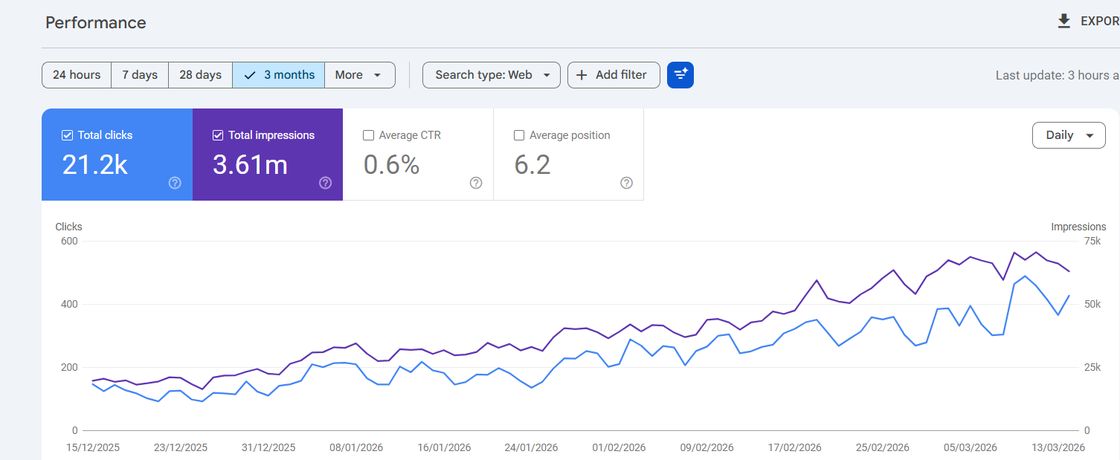
Zoom into a single quarter and you see the same trajectory at higher resolution: a steady, compounding climb, not a one-off jump.
It showed up as real audience growth
Rankings that do not produce visitors are vanity. Analytics confirmed the search gains turned into people, with active users up nearly 300% year on year.
And the phone rang
The metric that actually maps to revenue is calls placed straight from the Google Business Profile. For a clinic, this is as close to a booked patient as analytics gets.
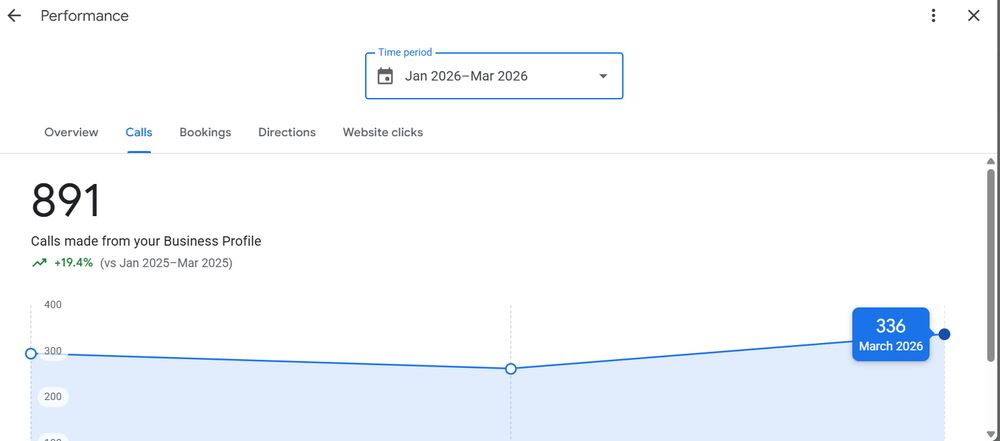
Clicks and impressions rose together while average position fell from 19 to 6.5, the textbook signature of broad ranking gains rather than a single fluke. More importantly, the visibility converted: hundreds of real calls and a near-tripling of site audience. Organic search became this clinic's leading source of new patients.
Want to know what is capping your clinic's growth?
Most practices have one constraint doing the real damage. I will find yours in a free growth diagnostic, the same diagnosis that started this project. No pitch, no obligation.
08 · The timeline
How it unfolded, month by month
SEO is not linear. It is a slow build followed by a compounding curve. This is roughly how the six months played out.
Foundation and discovery
Technical fixes, crawl and index cleanup, and the full audit. Little visible movement yet; this is the groundwork that makes everything after it possible.
Intent-mapped pages go live
Condition, treatment, and location pages ship and start to get indexed. Early ranking movement appears on lower-competition terms first.
Authority and local kick in
Trust signals, profile optimization, and review velocity begin to lift both the map presence and core rankings. Clicks start a steady climb.
The compounding curve
Rankings cross onto page one across the board, impressions and clicks accelerate together, and calls from the Business Profile climb. The channel becomes the clinic's primary new-patient source.
A note on proof
No cherry-picked quote here
I could have dropped a glowing one-line testimonial in this spot. I would rather you trust the dashboards above, which are unedited and pulled straight from the clinic's own Search Console, Analytics, and Business Profile. When the owner gives me a line I am allowed to share publicly, it will live right here, with their permission and nothing invented. Until then, the numbers can speak for themselves.
09 · The honest read
What worked, and what to keep in mind
What did the heavy lifting
- Intent-to-page architecture. Matching real searches to purpose-built pages was the single biggest lever I pulled.
- Local plus reviews. In a category this local, the Business Profile and review velocity drove both visibility and trust.
- Conversion clarity. Making the call the obvious next step is what turned rankings into actual patients.
The honest limits
- These are one clinic's results, not a guaranteed outcome. The method repeats; the exact figures depend on demand, competition, and starting point.
- The gains rely on ongoing review velocity and the clinic's capacity to handle the demand it now creates. Stop feeding the local signals and momentum fades.
- Healthcare is a slower, trust-sensitive space. This took months of foundation before the curve appeared, and it should.
- In healthcare, organic search is a patient-acquisition pipeline, not a side channel.
- Find the constraint before adding volume. More content on a broken foundation does nothing.
- Map pages to how patients actually search, not how the clinic describes itself.
- Treat local and reviews as core ranking infrastructure, not housekeeping.
- Measure success in calls and bookings, not impressions.
10 · Questions
Frequently asked questions
How long does healthcare SEO take to show results?+
Is a result like this repeatable for other clinics?+
Does this work for a single-location practice?+
How do you publish results without exposing patient or client data?+
Is paid search not faster than this?+
How is success measured in a case like this?+
How would an engagement like this start?+
Let me find what is capping your clinic's growth.
I will give you a free growth diagnostic of the single biggest constraint holding your organic growth back, the same diagnosis that started this case study. No pitch, no obligation, just a clear read on what to fix first.
Hiring or evaluating for a role? Email me directly or connect on LinkedIn.